
(Kalamata, Greece 26–27 August 2026)
From the roots of tradition to new narratives for the future, the “Routes of the Olive Tree” continue to build cultural bridges across the Mediterranean and Europe.
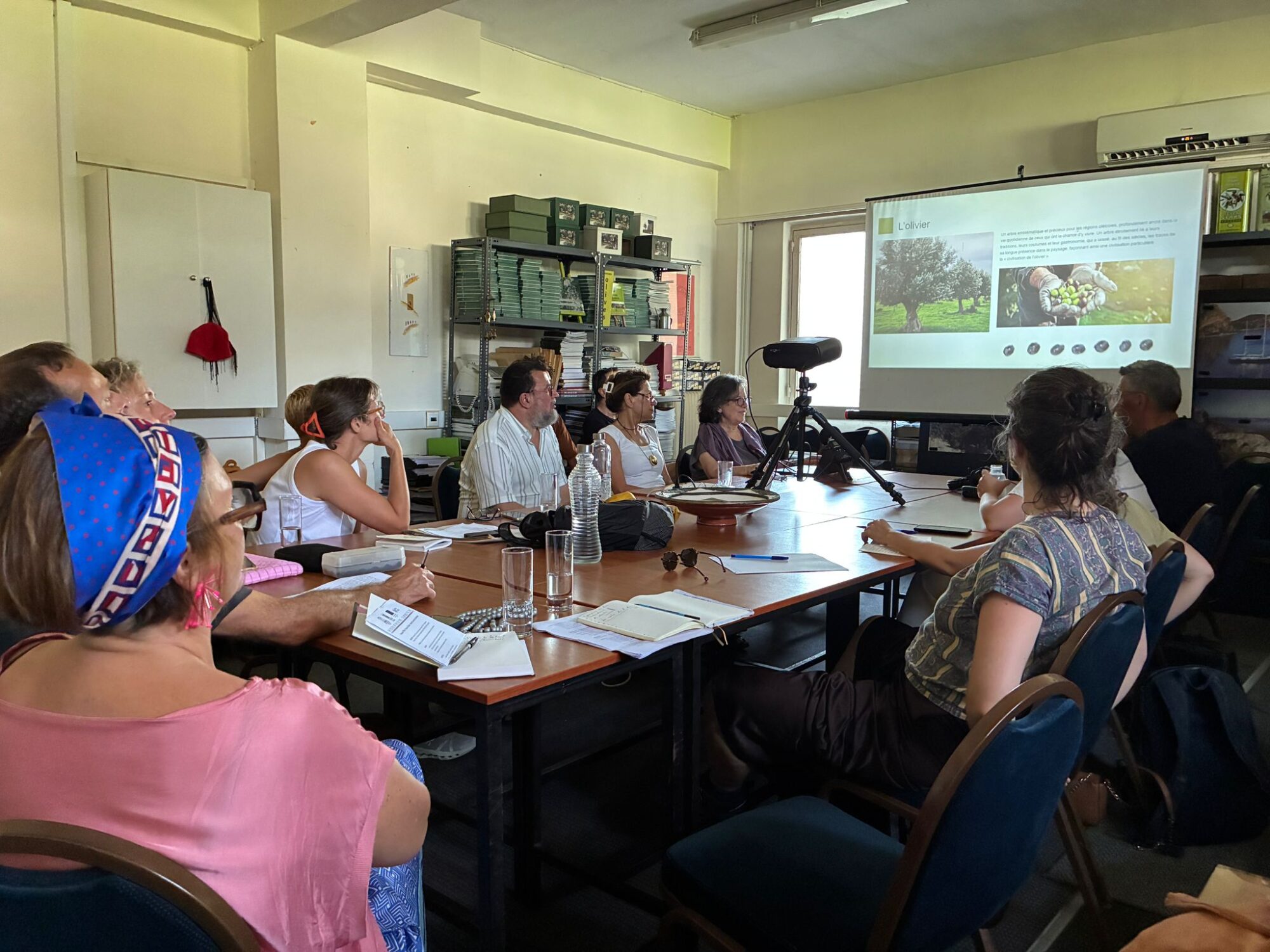
The Cultural Foundation “Routes of the Olive Tree” welcomed to Kalamata a group of 11 graduates of the Cultural Project Management programme of Sciences Po and the Observatoire des Politiques Culturelles in Grenoble (France), as part of the European programme “Culture, Territories and New Living Narratives in Greece.”
The educational and cultural visit aimed to introduce participants to institutions, artists, creators, producers and rural stakeholders whose work is redefining the relationship between cultural heritage, contemporary creation, the environment and sustainable development.
At the heart of the discussions was the question of how local communities can not only safeguard and transmit their cultural heritage, but also creatively reinterpret it, turning it into an active resource for the present and future of their territories.
A significant part of the programme was devoted to the work and initiatives of the Cultural Organisation “Routes of the Olive Tree”, with particular emphasis on ANIMA TERRA and on the potential of cultural routes as a means of connecting tradition with contemporary life.
The field visit demonstrated in practice how the living heritage of a place can find new forms of expression and become a platform for cultural dialogue, creativity, education, international cooperation and sustainable local development. In this context, a cultural route is not limited to showcasing the past; it connects cultural heritage with people, the natural environment, local production and contemporary artistic expression.
During the two-day programme, meetings and visits were organised at emblematic cultural and social spaces in Kalamata, giving participants the opportunity to explore different aspects of tangible and intangible cultural heritage.
Traditional costumes and folk culture were presented through the Victoria G. Karelias Collection of Greek Traditional Costumes, while coffee culture highlighted the importance of everyday social practices and meeting places. At the same time, the visit to the Kalamata Creative Documentary Center brought contemporary creation to the fore, highlighting the power of images and storytelling as means of documenting and reinterpreting a place.
Of particular interest was the visit to the Kalamata Central Market, where participants met and exchanged views with producers of local and traditional products, exploring the links between cultural heritage, the land, production and everyday life.
At the same venue, the OTRart mural was presented by Marinella Katsilieri, coordinator of the cultural programme of the “Routes of the Olive Tree”. The presentation highlighted yet another way in which contemporary artistic creation can engage with public space, local identity and cultural memory.
The connection between the Cultural Organisation “Routes of the Olive Tree” and Mucem – Museum of European and Mediterranean Civilisations (Marseille, France) played a key role in the organisation of this meeting, contributing to Kalamata’s participation in a broader Euro-Mediterranean dialogue of cultural cooperation and exchange.
Through such synergies, cultural heritage is approached not as a static remnant of the past, but as a living space where people, cultures and languages meet — a space where agriculture and the natural environment can interact with art, contemporary creation and new forms of cultural expression.
For the “Routes of the Olive Tree”, this meeting forms part of a long-standing effort to connect the olive tree and its culture with the contemporary challenges facing Mediterranean societies. Deeply rooted in the landscape, economy, traditions and everyday life of the Mediterranean, the olive tree remains a powerful shared point of reference, capable of connecting different places, people and cultures.
The “Routes of the Olive Tree” thus continue to transform the roots of Mediterranean heritage into routes of encounter, creativity and cooperation, opening new paths for culture and the sustainable development of territories.